
Patch Type & Size Guide · 13 min read
Your Logo Already Knows What Patch It Should Be
The best patch choice is rarely hiding in a list of materials. It is usually hiding in the smallest line, the tightest counter and the color transition your logo cannot afford to lose.
By 6Six Needles Team ·
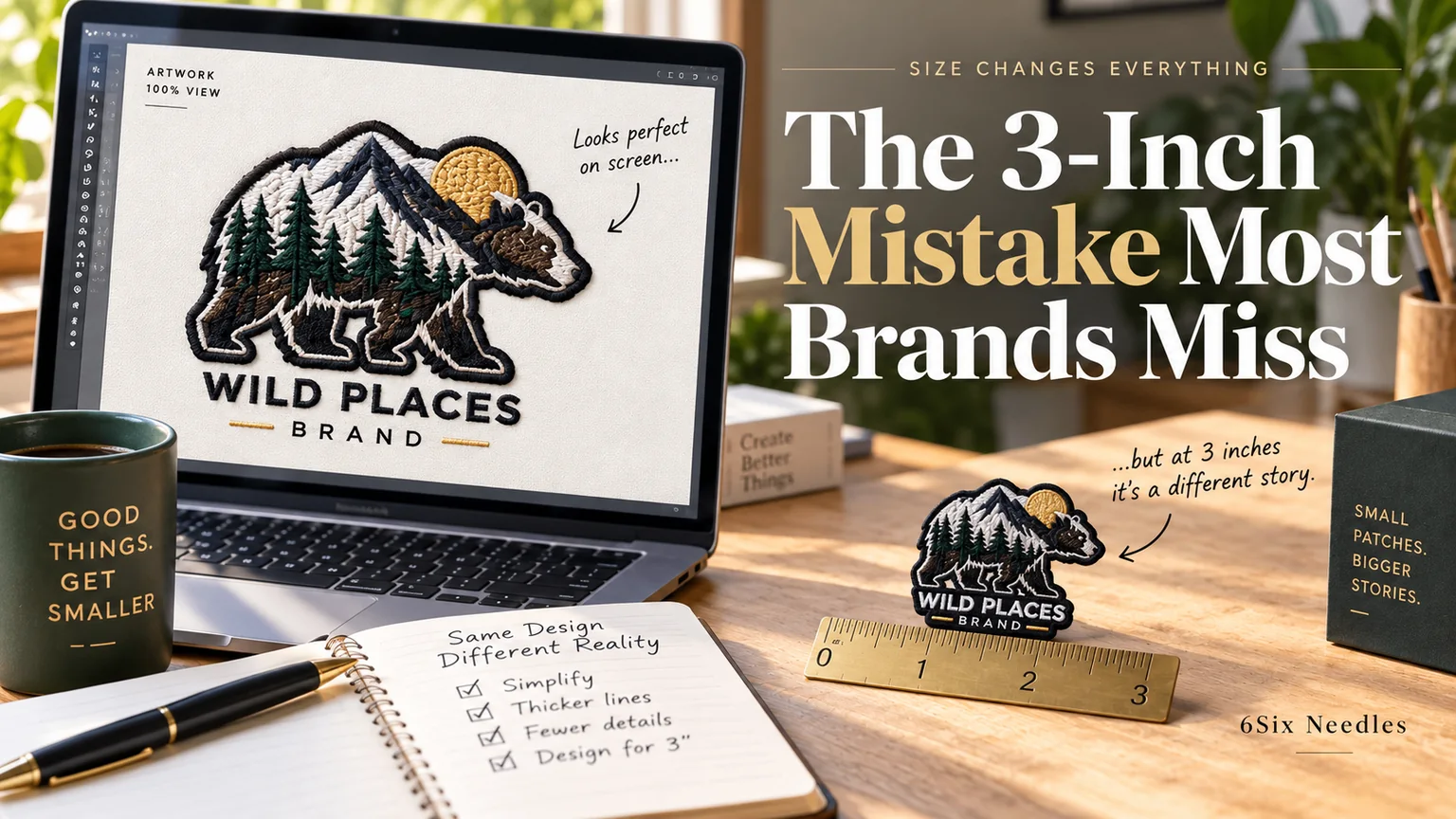
Open your logo on your phone for a second. Zoom in. See that tiny line under the lettering? The narrow space inside the R? The gradient behind the mascot? Those details may have already decided what kind of patch your logo should become.
On a screen, the design has light, pixels and effectively unlimited room. A patch has thread, molded material, fabric, borders and a fixed physical footprint. The problem usually appears when that 1,200-pixel logo becomes three inches wide.
That does not mean the design is bad. It means the useful question is not “Which patch type is best?” It is “What construction lets this artwork keep what matters at the size and placement I want?”
If you want the short path, the free Patch Advisor can start with the actual artwork. But first, learn what it is looking for. The clues are easier to see than most buyers expect.
Your design already has clues
Digital artwork and physical production speak different languages
A vector line can be mathematically perfect and still be too thin to read as thread. Negative space can look generous at 400% zoom and close up when a stitched border takes its share. A gradient can carry the mood of an illustration, then turn into four hard color bands when translated into another material.
Placement changes the equation too. A wide mark that sits naturally across a jacket back may feel squeezed on a cap front. The same artwork can favor embroidery at 4 inches and woven construction at 2.25 inches. Sometimes changing material is not the answer. Adding half an inch is.
Then there is the clue buyers often overlook: where the patch will spend its life. A soft jacket, a uniform, a gear bag and an outdoor morale panel ask the material to behave differently.
The 3-Inch Problem
As the cover demonstrates, a logo can look clean on a laptop: a crest, two rings of type, a narrow outline and a date tucked neatly underneath. Now shrink the whole thing to a 3-inch left-chest patch.
The tiny type is no longer alone. It competes with thread width, the outer border and the negative space that keeps neighboring shapes from merging. The letters may still exist in the file, but that is not the same as being readable on fabric.
The question is not simply “Is embroidery good?” It is “Can this artwork survive embroidery at this size?”
If not, you have three honest levers: give the design more room, simplify the smallest elements, or use a construction that carries finer information. Our broader guide to custom patch types compares the materials; this guide starts with the design and works outward.
Four Clues Hidden in Your Artwork
Read these as strong starting points, not laws. Size, placement and a small artwork adjustment can change the recommendation.
Clue 01
Detail
Look for: Tiny letters, hairline strokes and tightly packed linework.
Thread needs physical room. Woven construction or printing often holds more of that information at a small finished size.
When it can change: At a larger size—or after a thoughtful simplification—the same artwork may work beautifully in embroidery.
Clue 02
Texture
Look for: The design depends on bold shapes more than miniature detail.
Visible stitch direction and raised thread can become part of the look, making embroidery a strong starting point.
When it can change: If the mark must become very small, a flatter woven construction may keep its edges clearer.
Clue 03
Color behavior
Look for: Gradients, shading, photographic detail or subtle color transitions.
Printed construction can preserve continuous color changes that thread or molded PVC would translate into separate color areas.
When it can change: If those transitions can be simplified into deliberate flat colors, another construction may still fit the design.
Clue 04
Environment
Look for: The patch will meet rain, mud, repeated handling or outdoor gear.
Molded PVC is often a practical place to start because its surface suits wet, hard-use settings.
When it can change: On a soft everyday garment, weight, drape and the desired texture may point back toward thread.
A useful shortcut
Or You Could Just Show It Your Logo
Most patch guides ask you to learn all of those production rules first. You do not necessarily have to.
You can show the Patch Advisor the actual design, choose the item and placement, and describe how the patch will be used. It uses those details to recommend a patch type and a proportional starting width and height—without stretching the artwork into a preset box.
It is a starting point, not a production guarantee. The final proportions, readability and construction are confirmed in the mockup. That is exactly where judgment should stay in the process.
Start with the design you already have.
Free · No account needed · Start with your actual artwork
Now Look at the Material
Once the design clues are visible, the material list gets much shorter. Each construction gives you something—and asks you to give something up.
Embroidered
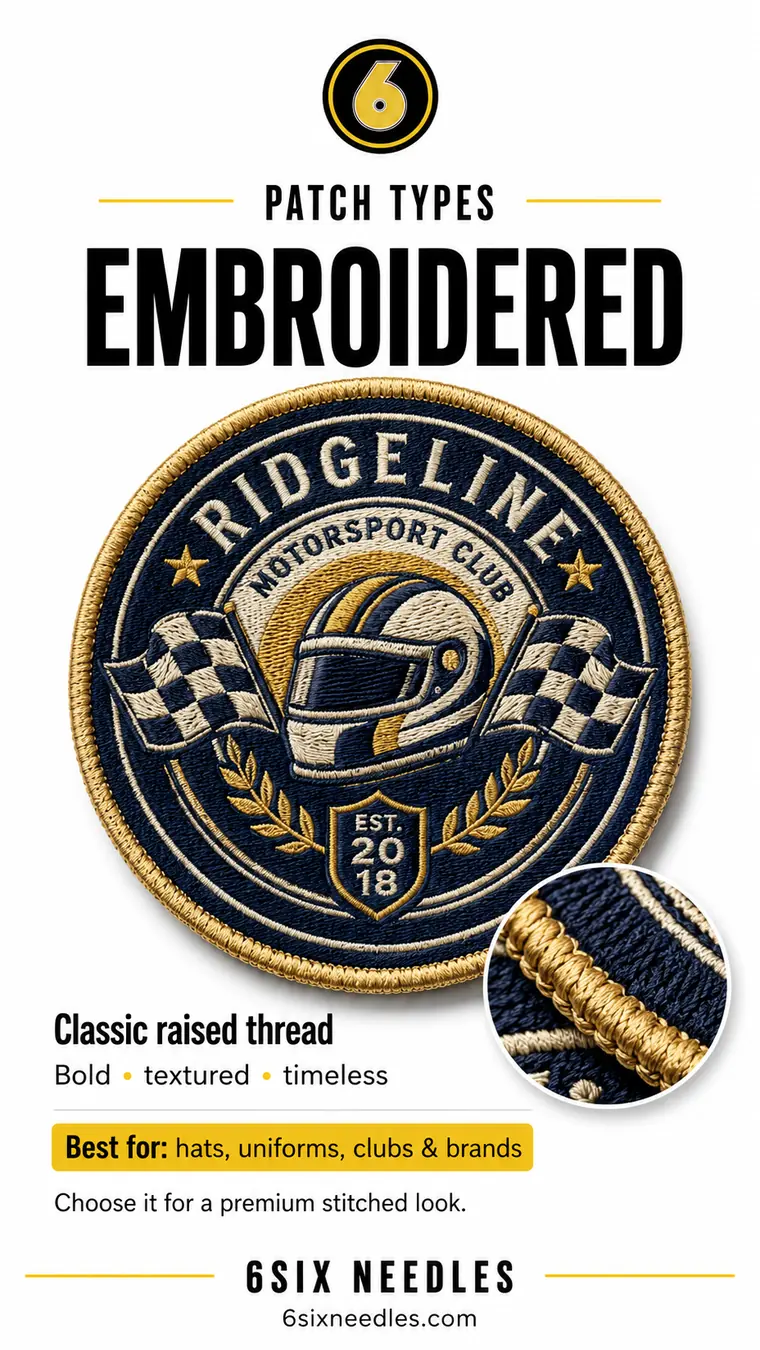
When people say “patch,” this is usually what they’re picturing.
Raised thread gives bold logos, crests and lettering a physical presence on hats, jackets, uniforms and everyday apparel. Extremely fine details may need more space or a simpler drawing.
Explore Embroidered Patches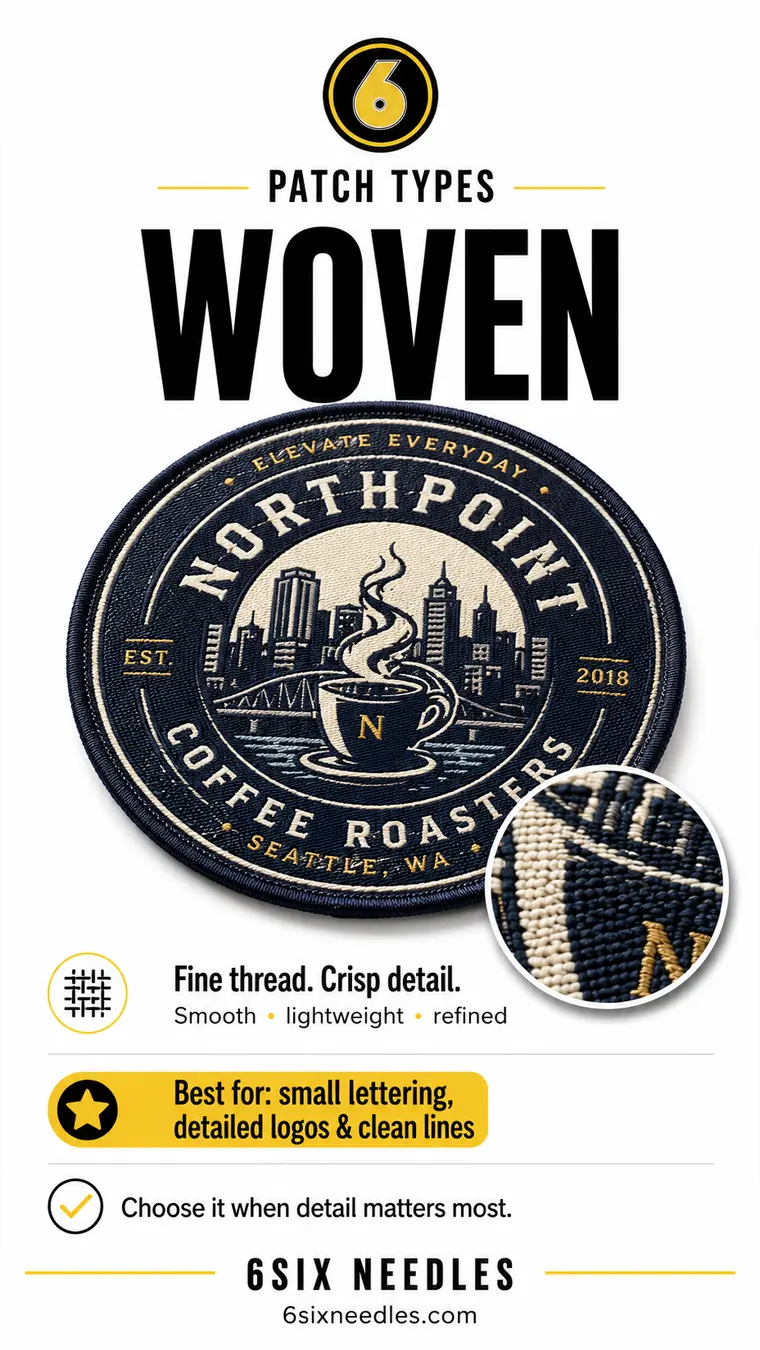
Woven
Think of woven as what happens when thread gets a finer pencil.
Finer threads and a flatter surface can hold smaller lettering, intricate linework and clean edges. You keep a textile patch, but give up some of embroidery’s raised texture.
Explore Woven Patches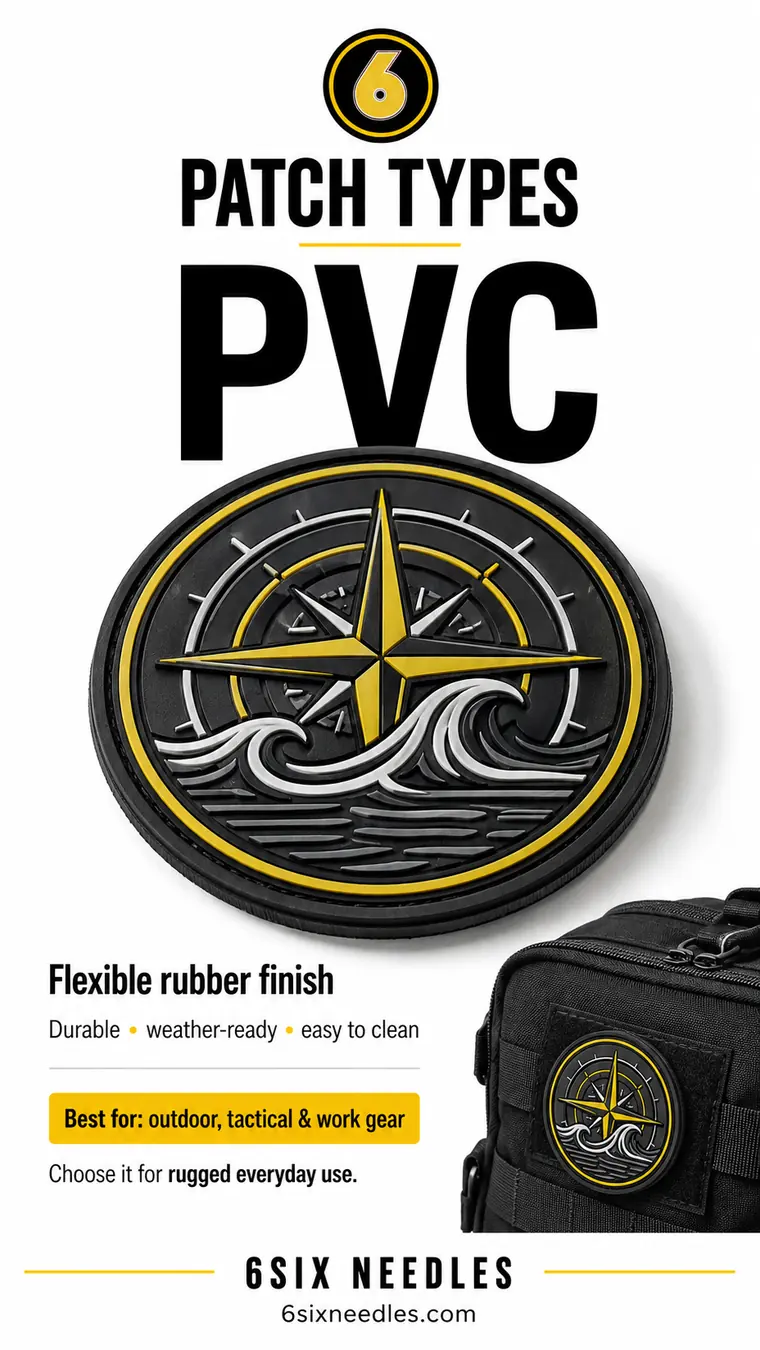
PVC
Some patches live on clean jackets. Others meet rain, mud and the floor of a truck.
PVC uses molded color areas and defined relief, making it a practical fit for outdoor gear and repeated handling. Its firmer rubber-like feel may be less natural on very light apparel.
Explore PVC Patches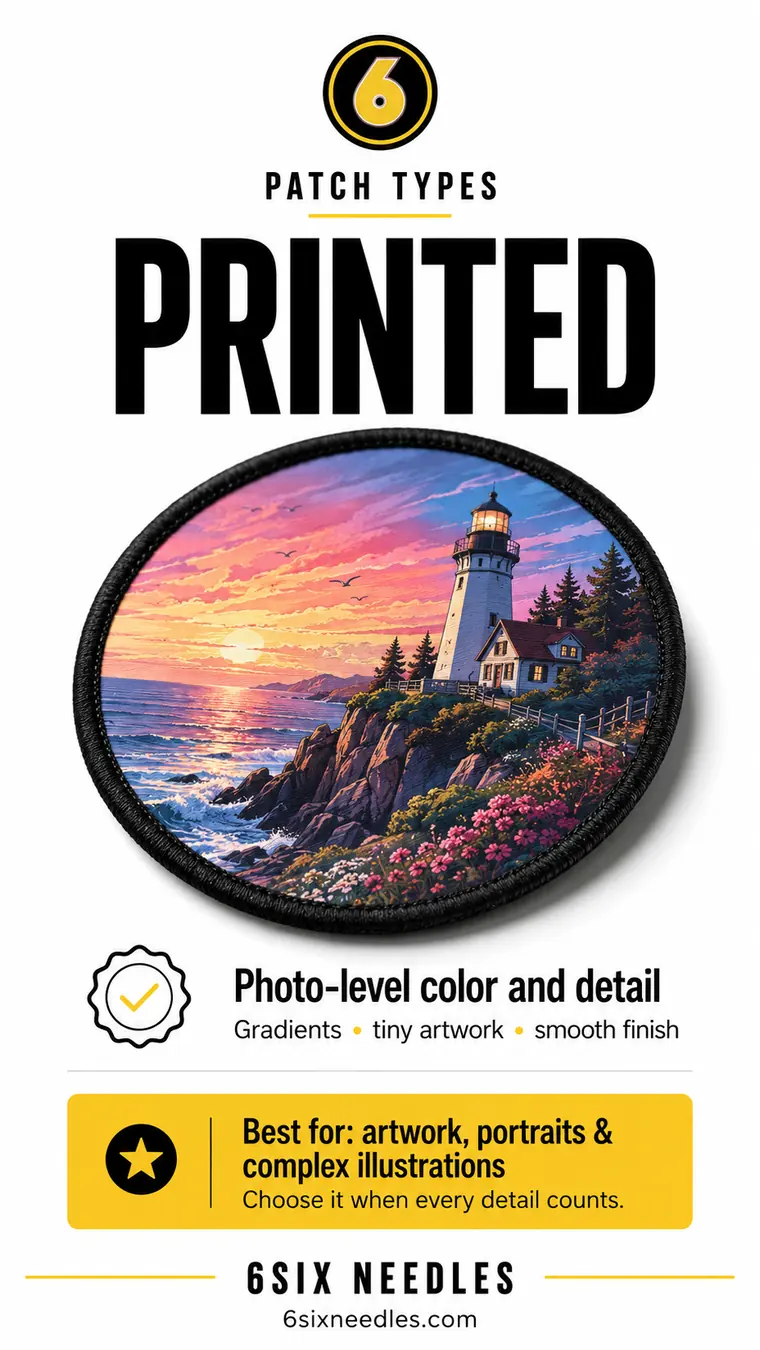
Printed / Sublimated
If the gradient is part of the design, don’t automatically turn it into flat thread colors.
Printing can preserve illustrations, shading and continuous color transitions. The finish is smooth rather than visibly stitched, which may be exactly right—or the wrong trade-off if texture is the point.
Explore Printed / Sublimated Patches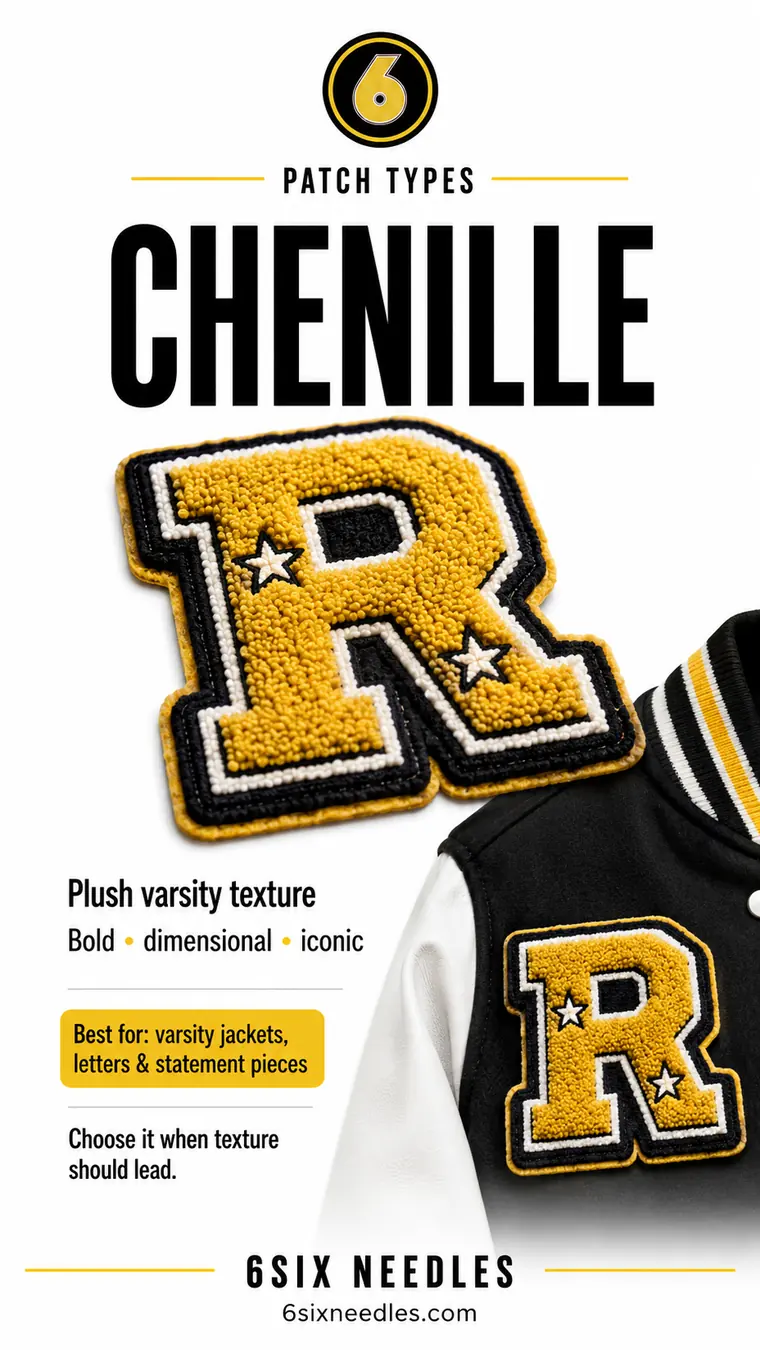
Chenille
Chenille doesn’t whisper.
Its plush varsity texture suits large letters, mascots and broad shapes. It needs room to work; miniature type and delicate linework fight the material rather than using it.
Explore Chenille Patches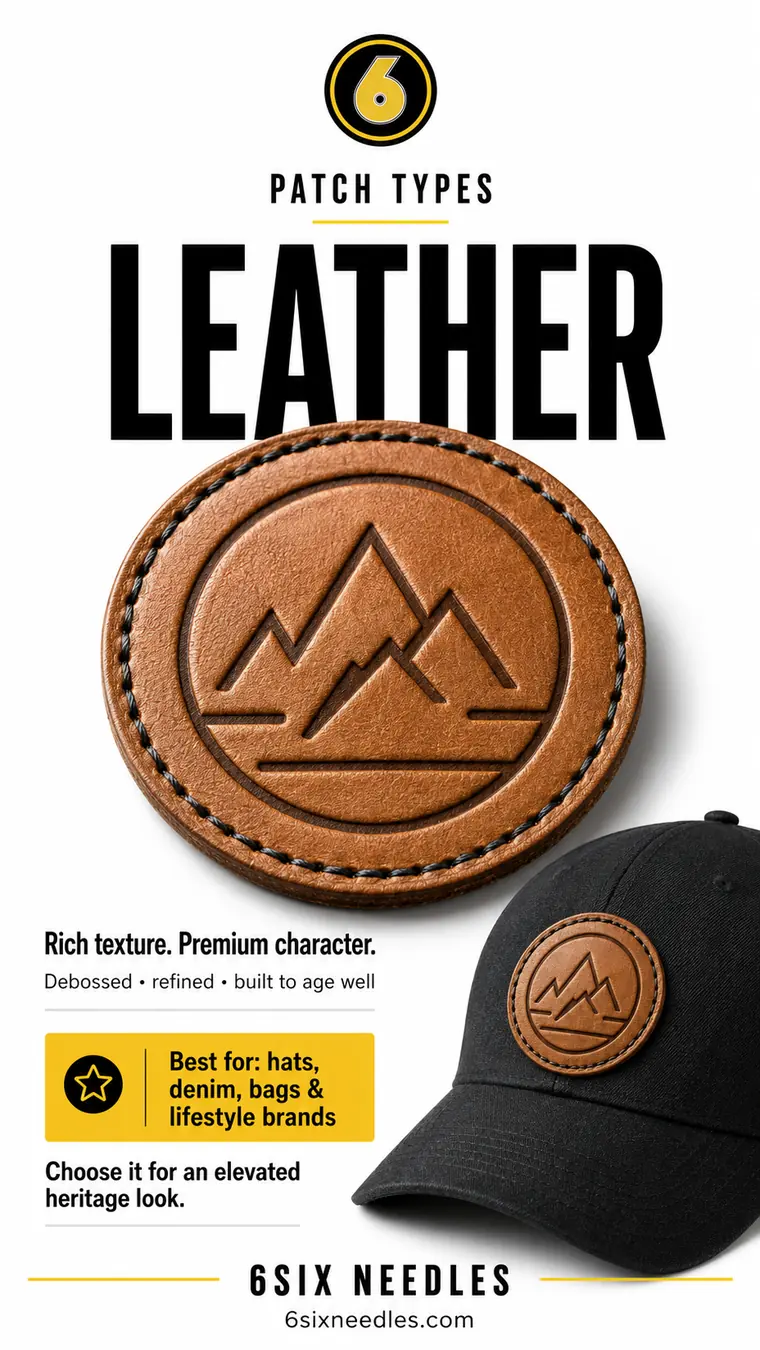
Leather
Leather works when restraint is part of the identity.
Engraved or debossed-style marks create understated, tonal branding for hats, denim, bags and workwear. It is better at silhouette, type and controlled detail than full-color illustration.
Explore Leather Patches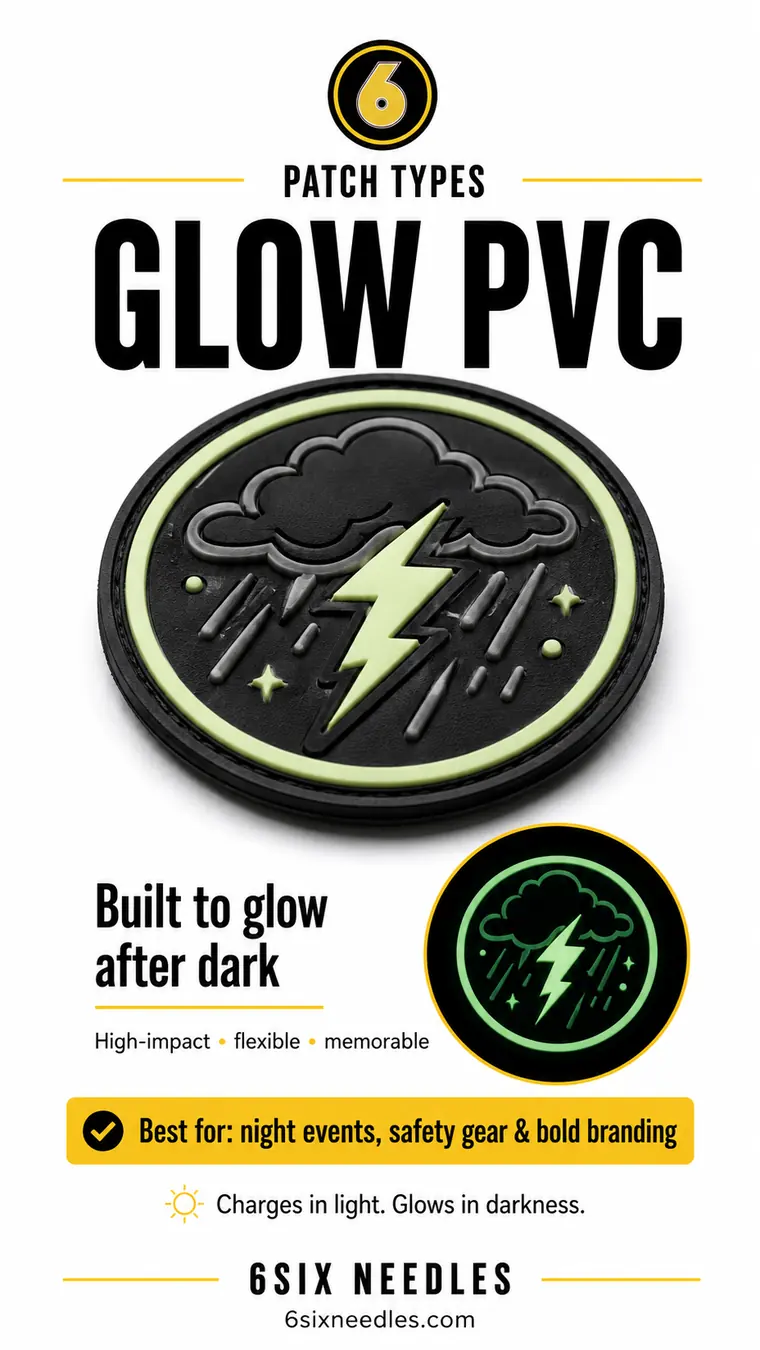
Glow-in-the-Dark PVC
Glow is a specialized material decision, not a substitute for a readable design.
It starts with the same molded logic as PVC, then uses light-reactive areas for a specific after-dark effect. The mark still needs clean shapes and deliberate contrast in normal light.
Explore Glow-in-the-Dark PVC PatchesThen Size Changes the Answer
Imagine the same crest at 4 inches and 2 inches. At 4 inches, embroidery may have enough room for the letterforms and border. At 2 inches, woven may preserve the type more clearly. Make it smaller still, with gradients intact, and printing may become the sensible choice.
Proportion matters just as much. A wide logo should not be squeezed into a square simply because a size menu says “3 inch.” Finished size is width by height, and the second dimension should follow the artwork.
Backing Isn’t a Style Choice. It’s a Use Question.
The right construction answers what the face should be. Backing answers what the patch needs to do after it arrives.
- Sew-on
- A durable, permanent choice for a jacket, uniform, cap or bag when stitching is practical.
- Iron-on / heat seal
- Convenient when both the patch and the specific garment are compatible with the required heat and pressure.
- Hook-and-loop
- Useful when a morale patch, uniform identifier or gear patch needs to be removed, swapped or repositioned.
The iron-on, sew-on and hook-and-loop backing guide walks through garment compatibility, permanence and reuse in more detail.
Same Logo. Different Answer.
These are hypothetical production examples—not customer stories. Their point is to show how artwork, size and use combine.
Example A · Coffee shop
A bold circular mark with large lettering at 3.5 inches on a jacket has room for visible stitch texture. Embroidered is a strong starting point.
Example B · Club crest
A detailed crest with tiny lettering at 2.25 inches on a hat may point toward woven construction—or a simplified arrangement with fewer words.
Example C · Illustrated merch
An illustration built around gradients and shading will often retain more of its character as a printed or sublimated patch.
Example D · Outdoor gear
A bold mark expected to meet mud and rain, attached with hook-and-loop to gear, is a practical PVC candidate.
What about yours?
A Mockup Should Answer the Questions the Guide Can’t
Recommendations are starting points because artwork proportions, text readability, borders and material colors vary. A mockup should make those choices visible before payment—not ask you to imagine the result.
You review and approve your free digital mockup before paying. After payment, we make a real sample and send you a photo of it to approve before the full production run begins.
- Send the artwork and project detailsShare the design, intended size, placement, quantity and backing—or start from an Advisor recommendation.
- Review the digital mockupCheck proportions, lettering, border and overall arrangement before payment.
- Approve and payThe invoice comes after you approve the digital mockup.
- Review the real sample photoAfter payment, the first real sample is produced and photographed for your approval.
- Full production beginsThe remaining run starts after sample approval, then ships with tracking.
Every custom patch type starts at 5 pieces: embroidered, woven, printed, chenille, leather, PVC and glow-in-the-dark PVC. Larger quantities simply lower your per-piece price. No setup fees. Standard turnaround: 10–14 business days after sample approval. Tracked Shipping | No Extra Charges.
See the work without invented project stories in the 6Six Needles real-work gallery, or browse the full custom patch collection.
Questions People Usually Ask Next
What patch type is best for my logo?
It depends on what the artwork asks the material to do. Bold shapes and visible texture often suit embroidery; very fine detail can favor woven; gradients and illustrations often point toward printed; and rugged outdoor use can make PVC practical. Finished size can change the answer.
Is woven or embroidered better for small text?
Woven construction often preserves smaller lettering because it uses finer thread and a flatter surface. Embroidery can still work when the text has enough room, the strokes are substantial, or the patch is made larger.
Which patch type works best with gradients?
Printed or sublimated patches are usually the strongest starting point when smooth gradients are essential. Thread and PVC use defined color areas, so they may require the artwork to be simplified.
What patch type works best outdoors?
PVC is often well suited to rain, mud, gear and repeated handling. The right answer still depends on the item, desired flexibility, artwork and attachment method.
How small can lettering be on a patch?
There is no reliable universal minimum because font shape, stroke weight, thread direction, contrast and construction all matter. Judge the exact lettering at the intended finished size, not only on a large screen.
What patch size should I use on a hat?
For a cap front, about 2.25 to 2.75 inches high is a useful starting range, with 2.5 inches recommended. Width should follow the artwork's proportions and the available crown area.
Should I use iron-on, sew-on or hook-and-loop?
Sew-on is a strong permanent choice, iron-on is convenient when the patch and garment are heat compatible, and hook-and-loop suits patches that need to be removed or exchanged. Choose for the item and how it will be used.
Can the Patch Advisor recommend a size from my artwork?
Yes. It uses the artwork's proportions with the selected item and placement to recommend a proportional starting width and height without stretching the design.
Can I see my design before paying?
Yes. For custom patch orders, you review and approve the digital mockup before payment. After payment, a real sample is made and its photo is sent for approval before the full production run.
What happens if my artwork is too detailed for the size I want?
The useful options are usually to increase the size, simplify the smallest details, strengthen thin strokes, or choose a construction that can hold more information at that scale. The mockup is where those trade-offs become visible.
Your design already has the clues
Look at it one more time.
Go back to your logo. Look at the smallest word. The thinnest line. The colors that cannot disappear. Then think about where the patch is going to spend its life.
You probably know more about the answer now than you did five minutes ago. And if you would rather not guess the rest, that is exactly what the Patch Advisor is for.
Free to use · No account required