
Placement Guide
Uniform Patch Placement Guide: Scout, Military-Style and Work Shirts
By 6Six Needles Team ·
Where each patch goes on Scout uniforms, military-style shirts and company workwear, plus the simple measuring routine that keeps every patch level.

Before you start: rules come first
Many uniforms have official placement rules. Scouts follow their organization's insignia guide, service members follow their branch regulation, and many companies have a brand standard. This guide covers the common positions, but when your organization's current rules say something different, follow those.
Scout uniform patch placement
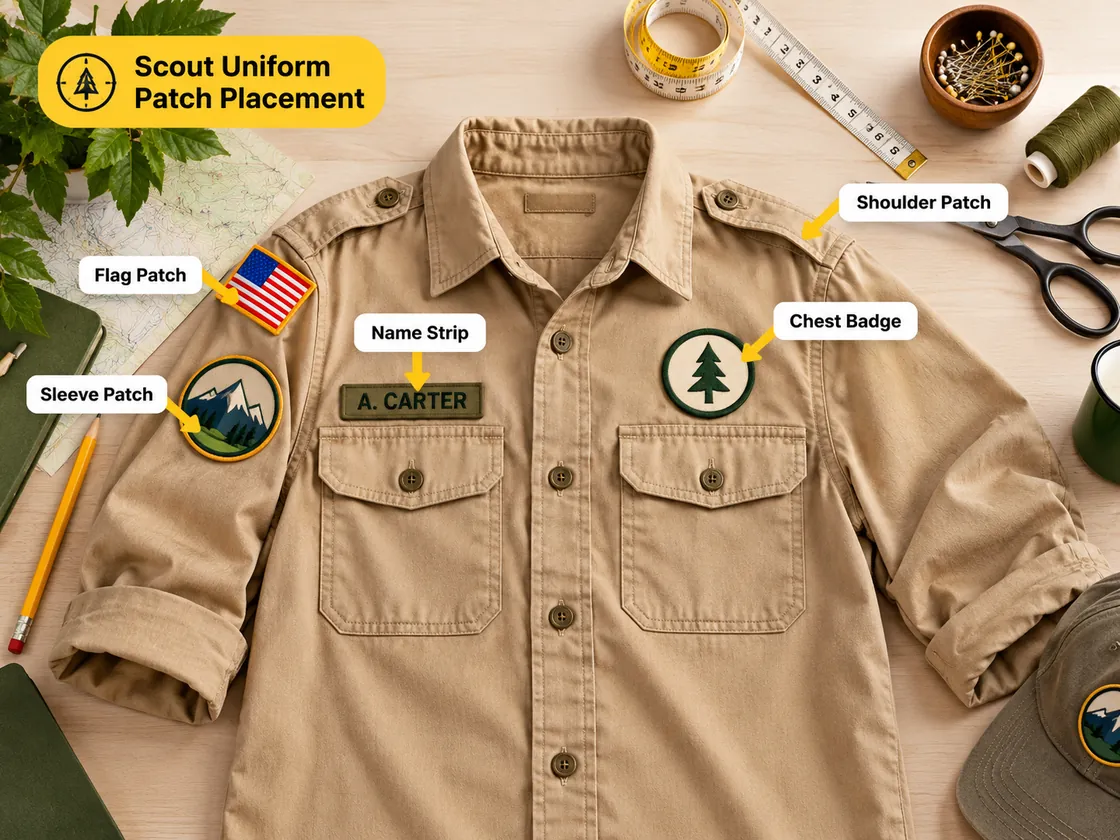
Scout uniform shirts follow a consistent layout: identity on the sleeves, rank on the left pocket and temporary patches on the right pocket. Here is the usual layout for a Scouts BSA field uniform shirt. Check the current Guide to Awards and Insignia for your program before sewing, since rules can change.
| Position | What usually goes there |
|---|---|
| Left sleeve, top | Council shoulder emblem, worn right at the shoulder seam. |
| Left sleeve, below the council emblem | Unit numerals, directly underneath and centered. |
| Right sleeve, top | U.S. flag emblem, worn at the shoulder seam. |
| Right sleeve, below the flag | Patrol emblem (Scouts BSA) or den emblem, centered under the flag. |
| Left pocket | Rank badge, centered on the pocket. |
| Above the left pocket | World Crest, centered between the shoulder seam and the top of the pocket. |
| Right pocket | Temporary patches such as camp or event patches, centered on the pocket. |
Tips for Scout shirts
Pin everything before sewing a single patch so you can see the whole layout. Sleeve patches are easiest to sew by hand because the sleeve is narrow. For badges you plan to move to a new shirt later, use small, neat stitches that are easy to unpick.
Military-style and tactical uniform placement
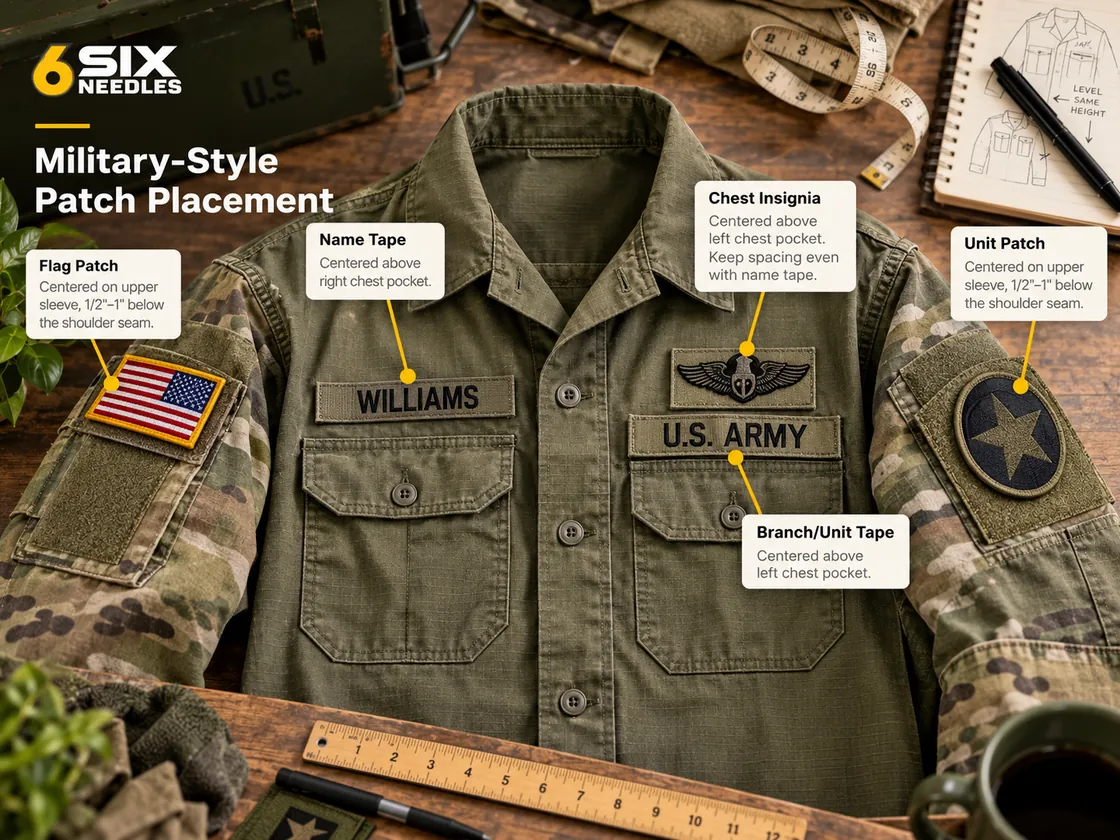
Modern combat-style uniforms use hook-and-loop fields on the shoulders and chest, so most patches attach and come off without sewing. The general layout looks like this. Exact positions, sizes and the flag's orientation are set by each branch's regulation.
| Position | What usually goes there |
|---|---|
| Shoulder pockets (hook-and-loop) | Unit insignia on one shoulder and a flag patch on the other, on the hook-and-loop field. |
| Above the chest pockets | Name tape and branch tape, centered over each pocket. |
| Chest hook-and-loop field | Rank tab, on uniforms that carry it at the center chest. |
| Bags, plate carriers, caps | Morale, ID and blood-type patches on hook-and-loop panels. |
Making unit, morale or team patches? See custom military patches, tactical patches and hook-and-loop patches.
Work shirt and company uniform placement
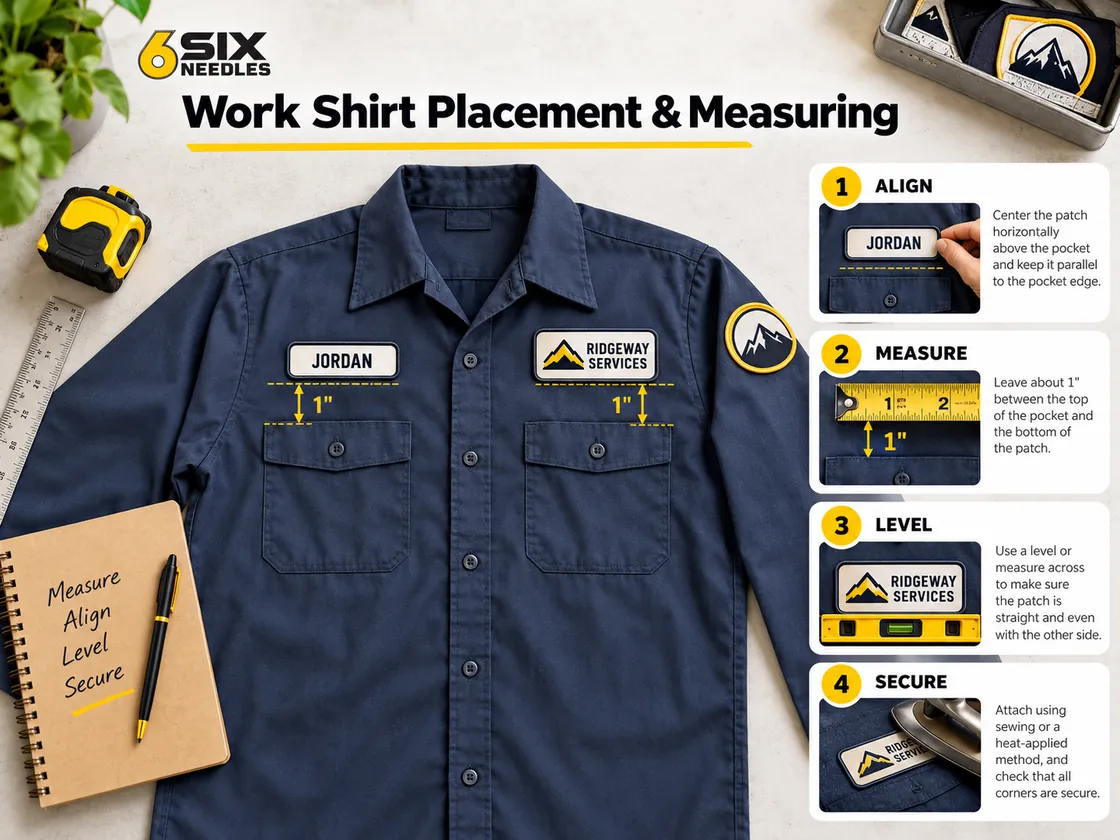
Company uniforms have more freedom, but customers and staff read them the same way: logo on the left chest, name on the right, extras on the sleeve.
| Position | What usually goes there |
|---|---|
| Left chest | Company logo, roughly 3 to 3.5 inches wide, centered over the heart area or the pocket. |
| Right chest | Name patch or employee ID, level with the left-chest logo. |
| Sleeve | Secondary logo, certification or flag patch, a little below the shoulder seam. |
| Upper back | Large company name or logo for visibility on site, centered between the shoulder blades. |
More on choosing materials and sizes in our work shirt uniform patch guide and on the custom uniform patches page.
How to measure so every patch sits level
- Button the shirt and lay it flat, front facing up, with no wrinkles.
- Pick a fixed reference: the shoulder seam for sleeves, the pocket top or seam for the chest.
- Measure the same distance on both sides when patches should match left and right.
- Pin or glue-stick each patch, then try the shirt on and check it in a mirror.
- Attach the patch only after the whole layout looks right.
Ready to attach? Follow our step-by-step sewing guide or how to iron on a patch. For sizes, see the patch size chart.
Common questions about patch placement
How far below the shoulder seam should a sleeve patch go?
For most uniforms the first sleeve patch sits right at the shoulder seam or just below it. On Scout uniforms the council emblem and flag touch the seam. On work shirts, around half an inch to one inch below the seam reads cleanly. Always follow your organization's current rules when they specify a position.
Which side does the American flag patch go on?
On Scout uniforms the flag emblem is worn at the top of the right sleeve. Military uniforms also place the flag on the shoulder, and its orientation and side follow the branch's current regulation, so check your unit's rules before attaching it.
How do I keep a patch straight while attaching it?
Button the shirt and lay it flat, measure from a fixed point like the shoulder seam or the pocket edge, then pin or glue-stick the patch before sewing. Check it on the body once before the final stitch, because sleeves curve.
Should uniform patches be sewn on or ironed on?
Sew-on is the most reliable for uniforms that are washed often. Iron-on is quick for suitable fabrics but can lift over many washes, so many people iron first and then stitch the edge. Hook-and-loop is standard where patches need to come off.
Need patches for your uniforms?
Send your artwork and we return a full-color digital mockup within 24 hours. Nothing is produced until you approve it.
Get My Mockup